
Cap and Trade vs LCFS: What's the Difference in California?
Cap-and-Trade and the Low Carbon Fuel Standard both came out of AB 32 and both are run by CARB, but they work differently and cover different entities. How each program functions, where they overlap, and why EV fleets should care about the LCFS specifically.
California, with a population of close to 40 million, is a big player when it comes to confronting climate change. The state’s comprehensive and aggressive policies serve as a model for other states and countries making strides toward addressing the climate crisis. In 2006, the state passed the California Global Warming Solutions Act (AB 32), which set ambitious goals for reducing greenhouse gas (GHG) emissions.
Two GHG reduction programs came out of AB 32: Cap-and-Trade and the Low Carbon Fuel Standard. They complement each other and help ensure California meets its emission reduction goals. The California Air Resources Board (CARB), the lead agency for the state’s climate efforts, oversees both. CARB also oversees all air pollution control efforts in California, including the Zero-Emission Vehicle program and the Air Quality Improvement Program.
What are the major sources of greenhouse gas emissions in California?
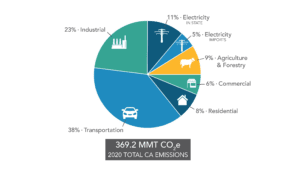
According to CARB, transportation is the largest source of greenhouse gas emissions in the state, at 38 percent of total inventory. The Low Carbon Fuel Standard exclusively covers entities in the transportation sector, while Cap-and-Trade covers heavily polluting entities across a variety of sectors: electricity producers, fuel distributors, industrial facilities, transportation, agriculture, and forestry. Entities that produce or import fuels, such as oil companies or biofuel producers, could fall within the scope of both programs.
What is Cap-and-Trade in California?
Cap-and-Trade is a market-based policy tool that does not rely on taxpayers to function, and is used to reduce greenhouse gas emissions. It covers entities that emit 25,000 metric tons or more of carbon dioxide equivalent emissions annually. What does that look like? According to the EPA, a metric ton of carbon dioxide is equivalent to 113 gallons of gasoline consumed. California’s program encompasses approximately 450 entities accountable for 85% of the state’s greenhouse gas emissions.
Under a cap-and-trade system, the government sets a limit, or cap, on the total amount of greenhouse gas emissions that can be released within a certain time period, typically a year. This cap is divided into allowances, which are distributed to companies or other entities that emit greenhouse gases. Companies can then buy and sell these allowances on a market. Those able to reduce emissions below their allotted cap can sell excess allowances to companies that cannot meet their targets. This creates an incentive to reduce emissions and rewards those that do so.
The cap is gradually reduced over time, and the number of allowances available for purchase is reduced along with it, creating an incentive for companies to invest in cleaner technologies. While fossil fuels are still consumed under Cap-and-Trade, the program is not a permit to pollute.
What is the Low Carbon Fuel Standard (LCFS) in California?
The Low Carbon Fuel Standard is a regulatory tool that requires the reduction of carbon intensity in transportation fuels specifically, and does not apply to other industries such as agriculture or electricity generation. A carbon intensity (CI) benchmark is set at a certain number of grams of carbon dioxide equivalent emitted per megajoule (gCO2e/MJ). Carbon intensity accounts for the entire life cycle of the fuel, from production to combustion or consumption.
Low-carbon fuels below the benchmark generate credits based on the current LCFS credit price in the market, while fuels above the CI benchmark generate deficits. Credits and deficits are denominated in metric tons of GHG emissions and are transacted on a private market. Regulated entities that produce fuels with higher carbon intensities must purchase these credits every 90 days to continue to operate within the state.
Under the LCFS, fuel producers and importers are required to meet a decreasing carbon intensity standard over time. They can do this by producing or importing fuels with lower carbon intensity than the standard, or by purchasing credits from other producers or importers who have exceeded the standard. The program also includes provisions to encourage the development of low-carbon fuels such as hydrogen and electricity.
What are the differences between Cap-and-Trade and the LCFS?
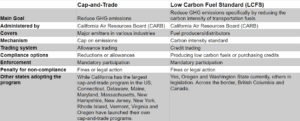
One of the biggest differences is that Cap-and-Trade is truly a market-based policy, meaning market factors alone affect the price of allowances. The government is more hands-on with the LCFS, a regulatory policy, and can change credit pricing by changing the benchmark.
In contrast to the LCFS, Cap-and-Trade is specifically designed to create a market for emissions, where companies can buy and sell allowances to emit greenhouse gases. The goal of Cap-and-Trade is to create an economic incentive for companies to reduce their emissions below their allocated cap, whereas the LCFS seeks to incentivize the use of low-carbon fuels in the transportation sector.
Bringing it together
California’s Cap-and-Trade program and the Low Carbon Fuel Standard are both essential tools in reducing the state’s greenhouse gas emissions. Cap-and-Trade creates a market for emissions, incentivizing companies to reduce emissions below their allocated cap, while the LCFS seeks to incentivize the use of low-carbon fuels in the transportation sector.
While Cap-and-Trade is a market-based policy, the government is more hands-on with the LCFS, which is a regulatory policy. Ultimately, both policies complement each other and help ensure that California meets its goals for reducing greenhouse gas emissions. As California continues to lead the way in confronting climate change, other states and countries can look to these programs as a model for creating effective and comprehensive climate policies.