
Who's First in Line? EV Charging Credit Rights Across North America's Clean Fuel Programs
A program-by-program look at who has the first right to generate clean fuel credits from on-road EV charging in California, Oregon, Washington, New Mexico, British Columbia, and under Canada's federal Clean Fuel Regulations.
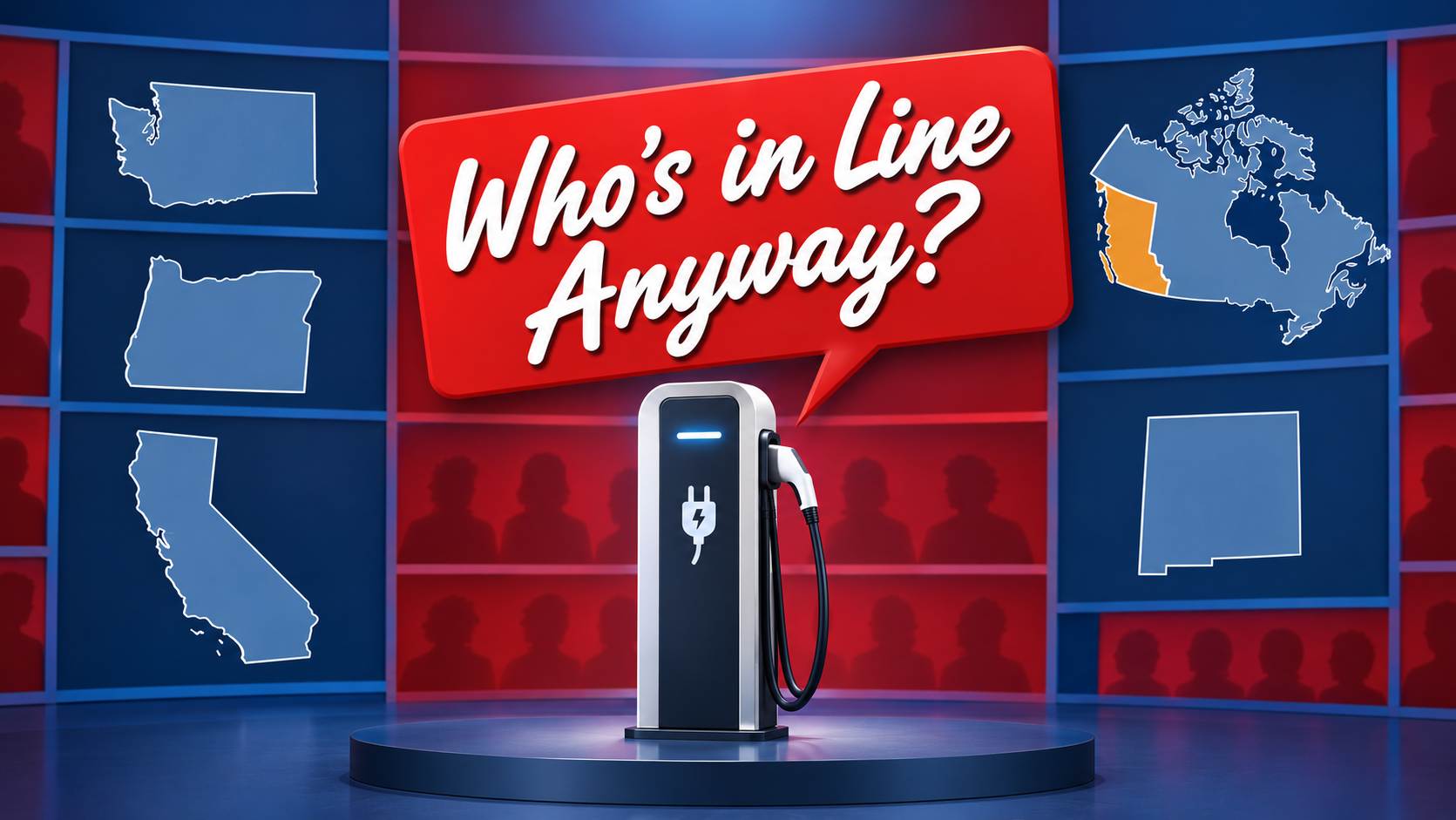
Every EV charger dispensing electricity to on-road vehicles in North America's clean fuel markets can generate valuable credits. But a charger can't generate credits on its own: someone has to register it, report its data, and claim the value. Who that "someone" is depends entirely on which program the charger sits in.
Six clean fuel programs are active across North America today: California's Low Carbon Fuel Standard (LCFS), Oregon's Clean Fuels Program (CFP), Washington's Clean Fuel Standard (CFS), New Mexico's Clean Transportation Fuels Program (CTFP), British Columbia's Low Carbon Fuel Standard (LCFS), and Canada's federal Clean Fuel Regulations (CFR). Each one answers the question "who's first in line?" a little differently, and the differences matter for charger owners, charging network operators (CNOs), software providers, site developers, installers, and OEMs alike.
Here's how each program assigns credit-generation rights for non-residential and residential on-road EV charging.
California LCFS: the owner, unless they sign it away
In California, the owner of a non-residential EV charger is first in line to generate LCFS credits.
If the owner doesn't want to generate credits themselves, they can designate a third party as the credit generator through a written contract. For many years, this designation happened quietly: a software provider, site developer, installer, or OEM would include language in its service agreement with the charger owner that transferred the credit rights to the provider. That is changing. Owners now better understand what LCFS credits are worth, especially with the decade-long implications carried by the Fast Charging Infrastructure provision. As a result, many now treat these credits as financial assets to weigh and negotiate well before a deal is signed.
What this means for owners: Do your due-diligence with your service agreements, and decide early if LCFS proceeds tip the scales of your project penciling out financially. Pause and seek regulatory clarity and explore your options before committing to signing over your rights to credits. Our inbox is always open for questions like these!
*Note on how to check whether your chargers are already registered in the CA LCFS: Each quarter, CARB publishes an updated inventory of LCFS Registered FSE for Non-Residential EV Charging. It lists every participating non-residential FSE (EV charging station) by address, along with the name of the entity currently claiming it. The list doesn't include serial numbers, but if you know there are, say, four EV chargers at an address and four FSEs appear there on the list, you can be fairly confident which chargers the registration covers.
Oregon CFP: the owner, then the network operator
Oregon also puts the owner of a non-residential EV charger first in line for CFP credits. The difference is what happens when the owner doesn't act.
If the owner isn't generating credits, the charging network operator can register the charger and generate credits itself, unless or until the owner decides to claim them. Unlike California, there is no carve-out for designating a third party by contract. The credit rights stay with the owner or the CNO.
Oregon also sets a documentation bar at registration: the registering entity must provide proof of ownership and proof that the charging asset is operational.
What this means for owners: your CNO may already be generating credits on your chargers. You can step in and claim them at any time, but you'll need your ownership and operational documentation ready.
Washington CFS: California's model, with required wording
Washington mirrors California. The non-residential charger owner is first in line, and can designate a third party as credit generator through a written contract.
The catch is that the contract must include specific language laid out in the regulation:
"Per WAC 173-424-220, <first fuel reporting entity> elects to waive credit generation under the CFS and allocate its credits to <designated entity>. <Designated entity> agrees to fulfill all CFS responsibilities as the fueling reporting entity and credit generator, and <first fuel reporting entity> agrees to provide electricity data to assist <designated entity> fulfill its reporting duties under the CFS."
What this means for third parties: a service agreement that works in California may not be enough in Washington. If your contract template doesn't include this wording, update it before relying on it for CFS designations.
New Mexico CTFP: California's model, with an upfront cost
New Mexico also mirrors California: the non-residential charger owner is first in line and can designate a third party as credit generator.
The difference is sequencing and cost. Before the owner can designate a third party, the owner must first register in the ARCS reporting system and pay the $3,000 registration fee. The designated third party must also set up its own ARCS account and pay its own $3,000 registration fee.
What this means for owners and third parties: a designation in New Mexico costs $6,000 in combined registration fees before any credits are generated. Make sure the expected credit volume justifies that cost, and agree up front on who bears it.
British Columbia LCFS: whoever pays the utility bill
British Columbia takes a different approach. Ownership of the charger doesn't decide credit rights; the utility bill does. The entity whose name appears on the utility bill for the electricity dispensed through the charger is the credit owner.
The utility account holder can transfer reporting responsibilities to another entity by signing an Allocation Agreement. These agreements come with two guardrails:
Term limit: an Allocation Agreement lasts up to three years at a time.
Transparency: the reporting entity must notify the original credit owner (the utility account holder) of the number of credits generated and the revenue received for them.
Threshold: It is important to note that the Ministry requires entities to annually report electricity dispensed to EVs via the LCFS. Unlike other North American programs where credit generators are considered "opt-in," the BC LCFS only exempts entities that charge less than 15,000 kWh across all the stations on their utility bill(s). For organizations below the mandatory reporting threshold, they can still participate and generate credits by signing an Allocation Agreement with another party that aggregates small fuel volumes.
What this means for site hosts: if the electricity account is in your name, you hold the credit rights, even if someone else owns or operates the charger.
Canada CFR: it depends on the setting
Under the federal Clean Fuel Regulations, the setting of the charger determines who can claim credits.
Private charging (fleet vehicles behind the fence, chargers at rental apartment complexes, and similar): the owner of the charger is eligible to claim credits.
Public charging: the charging network operator is entitled to claim credits.
Residential charging (Stratas, single-family homes, and any situation where the charger is owned by and intended for the resident of a private dwelling): the charging network operator is entitled to claim credits.
For public and residential chargers, the CNO is not obligated to notify the charger owner that it is participating in the CFR and generating credits.
In the event the charging site host (private charging) or CNO (public or residential) chooses to transfer credit rights to another entity, the two parties must file a Section 21 Agreement with Environment and Climate Change Canada (ECCC) in either one or both of their Credit and Tracking System (CATS) accounts.
Whether going it on their own as the Registered Creator or signing a Section 21 Agreement, it's important to keep an eye on the date the credit generator is allowed to start reporting charging activity:
For entities reporting their own activity in their own CATS account, charging sessions can be claimed starting the day after registering in CATS. Make sure your registration report reflects all the provinces and activity types for all deployed EV charging assets to maximize your credit generation potential!
For Section 21 Agreement holders, credits may only be generated from charging activity the day after the Agreement is submitted to ECCC, with a meaningful exception for filings done in the first 60 days of a given compliance year, which allows the activity to be backdated to January 1st.
Also, note that Section 21 Agreements are only effective for a single compliance year at a time, so the entities must be sure to file a new one each year the reporting responsibilities are transferred.
What this means for owners: if you own a public or residential charger in Canada, your network operator may be generating federal credits on it without telling you. If you operate private chargers, those credits are yours to claim.
At a glance
| Program | First in line | Fallback or transfer | Notable requirement |
|---|---|---|---|
| California LCFS | Non-residential charger owner | Third party designated by written contract | Often transferred via vendor service agreements |
| Oregon CFP | Non-residential charger owner | CNO may register and generate until owner claims; no third-party designation | Proof of ownership and operationality at registration |
| Washington CFS | Non-residential charger owner | Third party designated by written contract | Contract must include WAC 173-424-220 wording |
| New Mexico CTFP | Non-residential charger owner | Third party designated by written contract | Owner and designee each register in ARCS ($3,000 fee each) |
| British Columbia LCFS | Utility account holder for the charger's electricity | Allocation Agreement to another reporting entity | Up to 3-year terms; owner notified of credits and revenue |
| Canada CFR | Private: charger owner. Public and residential: CNO | Section 21 Agreement filed in CATS | Credit creation activities do not automatically backdate to the 1st of the year in most cases. |
Conflicting claims: what happens next?
Agencies administering the U.S.-based programs typically do not adjudicate competing claims for credits. Given how complicated the EV charging landscape is, they advise the entities involved to work out credit ownership amongst themselves. That's not to say regulators overlook a failure to provide legitimate documentation substantiating an ownership claim (you do not want to invoke the enforcement powers that be!). Rather, this young, evolving industry often involves multiple stakeholders to get new chargers in the ground and energized, and each could have a reasonable claim to the environmental attributes. Having seen many complex permutations of credit-rights assignment, here at FuSE we suggest any party interested in staking a claim to clean fuel program credits read their contracts carefully and, where it serves their interest, negotiate strategically to preserve their first-in-line status under the regulation.
British Columbia is stricter on the front end. The Ministry of Energy and Climate Solutions has a rigorous validation standard that requires copies of utility bills showing the credit claimant's entity name as the account holder, at a service address that must match the location of the reported EV chargers. The chain of proof extends to Allocation Agreement holders, who must show they have been designated by the appropriate first-in-line entity.
Now, we come to the Canada CFR: ECCC has a firm stance of not issuing credits to anyone when competing claims are made. If the same EV charger serial numbers show up on two different entities' Annual Credit-Creation Reports, both receive a whopping zero credits for the kilowatt-hours dispensed. Unfortunately, because there is no public registry available to Registered Creators or accredited verifiers, duplicate claims only come to light after verification has been paid for and compliance reports have been submitted to ECCC. To learn about ways ECCC and industry could improve this process without waiting on a regulatory amendment cycle, check out our recent Transparency by Design blog post.
The bottom line
Four of the six programs (California, Oregon, Washington, and New Mexico) put the non-residential charger owner first in line. British Columbia looks to the utility account holder, and Canada's CFR looks at how the charger is used.
For charger owners, the practical lesson is to know which program your chargers sit in and check whether you've already signed your credit rights away, or whether a CNO is claiming them by default. For CNOs, software providers, and other third parties, the lesson is that one contract template won't fit every market: Washington requires specific wording, New Mexico requires paid registrations on both sides, Oregon doesn't allow contractual designation at all, and British Columbia caps agreements at three years.
Getting the answer to "who's first in line?" right is the first step to making sure the credit value from your charging assets lands where it should.